Rare Toys. Strange Finds. Collector Obsessions.
The Six Faces of Ninja Robot: Tracing an Elusive Turtle-Bot Toy
TMNT Bootleg Toy
Ivan Juniper
10/29/20269 min read


At first glance, Ninja Robot seems to combine ideas that should not quite fit together. Its head has the rounded, reptilian look of a turtle; below it sits a plainly mechanical body, while ninja weapons add another layer of character. A large “S” on the belt is the most conspicuous marking, but its meaning is not immediately apparent. The result is an unusual vintage action figure that resists easy classification: part turtle, part robot, and part martial-arts hero. Even its name raises questions, suggesting a character identity without, by itself, revealing who designed or distributed the toy.
This mixture helps explain the figure’s appeal to several different collecting communities. Teenage Mutant Ninja Turtles collectors may notice the turtle-like head and ninja theme, while vintage robot enthusiasts may be drawn to its mechanical construction and distinctive silhouette. Collectors of unconventional figures have a reason to look, too: Ninja Robot brings familiar motifs together in a form that feels difficult to place alongside better-documented toys. Similarities to other characters can invite comparisons, but resemblance alone does not establish a connection, shared origin, or official relationship. The toy is intriguing precisely because its visible features offer clues while leaving their significance uncertain.
This article begins with examples found in boxes at Lisbon Unicorn Toys. They provide a starting point for investigating how many variants may exist, where the toy came from, and what surviving evidence can establish. Differences in appearance, accessories, or markings may help distinguish versions, but a handful of encountered figures cannot stand for every example ever made. Nor does an isolated detail settle questions of manufacturer, date, or intended market. The discussion therefore documents observed examples rather than presenting a complete catalogue. Its aim is to separate what can be seen from what remains speculation, and to trace the limits as well as the value of the clues that have survived.
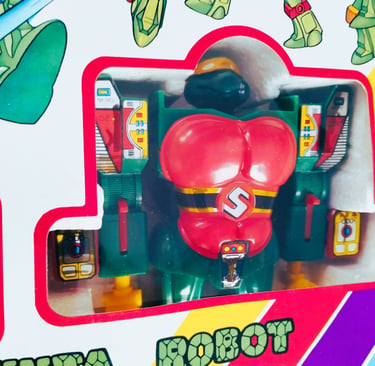
The figure’s most immediately visible feature is its green, mechanical-looking body, shaped around a head with a distinctly turtle-like profile. Its chest is covered by a brightly coloured plate, while small levers extend from the arms and suggest movable or powered components. Stickers depicting imaginary machinery add further detail to the surface. A belt crosses the figure’s waist, bearing a prominent “S” whose significance is not explained by any reliable description currently available.
These are observations of the toy itself, rather than confirmed clues to a particular character or story. The shell-like, turtle-associated form and mechanical limbs make the design’s combination of turtle and robot concepts readily apparent. However, visual resemblance alone cannot establish the figure’s intended name, the identity of its manufacturer, or whether the “S” represents a character, team, or other idea. Those details remain unconfirmed, and should not be treated as settled facts.
The packaging expands the impression created by the figure. Its artwork depicts turtle-like warriors equipped with robotic limbs and martial-arts weapons, presenting them as inhabitants of a vivid, action-oriented fictional world. The imagery implies a blend of science-fiction machinery and martial-arts adventure, but implication is not the same as documentation. No located catalogue or reliable account has established the world’s name, the depicted warriors’ identities, or how the toy relates to any larger product line. The box therefore provides useful evidence of how the toy was presented, while leaving its background unresolved. Taken together, the object and its packaging support a clear description of the design: a green turtle-like robot with colourful armour, mechanical embellishments, and an adventurous illustrated setting. They do not, on their own, verify the names, creators, or narrative that collectors might associate with it.
In collector discussions, “bootleg” is a flexible label for toys made or sold outside an authorized production or licensing arrangement. It can describe direct copies, objects that borrow distinctive visual elements, and toys that recombine familiar motifs into a new design. These categories are not always easy to distinguish from a photograph or a loose figure alone. A resemblance may reflect deliberate imitation, shared conventions in toy design, or coincidence; the label therefore signals a collector’s interpretation rather than, by itself, proof of a toy’s origin. Terms such as “knockoff” and “unofficial” are also used, sometimes interchangeably, although individual collectors may apply them differently.
Ninja Robot fits into this conversation because its turtle-like characteristics invite comparison with recognizable turtle-themed characters. That observation can help explain why collectors discuss it alongside unofficial or derivative toys, but it does not establish that the figure was licensed by, produced for, or officially connected to the Teenage Mutant Ninja Turtles franchise. Similarities in a shell, stance, or character concept are visual evidence only. Without supporting packaging, manufacturer records, dated advertisements, or other reliable documentation, a particular relationship should not be treated as confirmed. Careful descriptions distinguish what can be seen on the toy from claims about who designed, manufactured, or marketed it.
Some collectors may also compare Ninja Robot’s mechanical appearance with robot toys associated with Transformers knockoffs. Such comparisons can be useful when describing its visual style or placing it within broader collecting conversations. However, no shared mould, franchise relationship, or transformation feature has been established here. A robotic surface or mechanical styling does not demonstrate that a toy transforms, nor does resemblance establish common manufacture. Provenance requires evidence beyond appearance, such as verifiable markings or contemporaneous documentation. Until such evidence emerges, Ninja Robot is best discussed as an elusive turtle-like robot toy whose design prompts several comparisons, while its precise origins and connections remain unresolved. Keeping those points separate makes discussion clearer for collectors and readers alike.The most specific provenance clue currently associated with the Ninja Robot figures concerns their arrival at Lisbon Unicorn Toys. The shop received them in a shipment originating from Taiwan, alongside bootleg toys linked to Liveman and UFO Robot. This places the figures within a particular consignment and provides a useful lead for tracing how they entered the shop’s stock. It does not, however, establish where the Ninja Robot toys were made. A shipment’s point of origin records a route or dispatch connection; it cannot by itself identify the factory that produced every item carried in the same load or container.
That distinction matters because mixed consignments could contain products made by different companies or in different countries, even when they traveled together. The available account says the stock arrived without labels identifying its factory. No confirmed manufacturer, factory address, or original production location for Ninja Robot has been established in the records currently available. Taiwan is therefore a documented part of the shipment story, but not a verified manufacturing attribution. Treating the two claims as equivalent would turn a limited logistical clue into a conclusion that the surviving evidence does not support on its own or through independent corroboration today
Further progress would depend on evidence that connects this particular toy, rather than merely its shipment, to a maker or place of production. Packaging text could name a company, country, distributor, or licensing arrangement; factory marks on the figures might offer another lead. Dated catalogues could show when and where the design was sold, while import documents might distinguish the exporter, shipper, and manufacturer. Examples held by other collectors could also help, especially if their packaging or markings remain intact and their ownership histories are documented. These are research avenues, not discoveries established by the current provenance record for now.
Examining the boxes revealed six distinct colour combinations among the Ninja Robot figures present in the shop’s stock. This is the investigation’s clearest material finding: the examples differed in visible colour details, even though they shared the same general turtle-bot design. The six combinations are best treated as documented examples encountered during this examination, not as a complete catalogue or proof that only six versions were ever made. No reliable production list or comprehensive collector archive is available to establish the full range.
To make the variants useful for comparison, a full article should describe each figure using the same set of observations. Record the headband colour, chest plate, main body and limb details, and the colours or placement of any stickers. Note additional visible differences where present, while distinguishing colour variation from changes in sculpt, condition, or packaging. A consistent order makes descriptions easier to scan and helps readers compare figures without assuming that a single detail defines a variant. Labels such as “example one” through “example six” can identify the photographed specimens without implying an official edition numbering.
The record remains incomplete because surviving examples and collector notes may be scattered, partial, or based on descriptions that use different names for the same colours. Boxes can also obscure details, and ageing, lighting, or image quality can make colours difficult to judge. Photographs of each figure from comparable angles, supported by close views of the headband, chest, and stickers, would preserve evidence more effectively. Side-by-side images can reveal distinctions that are hard to communicate in prose, while neutral lighting and clear captions reduce ambiguity. Future owners can add new observations using the same labels and fields. In this way, the six shop examples provide a careful starting point for identification, while leaving room for additional colour combinations to emerge as more figures are documented.
Among the six Ninja Robot designs, the yellow-headband example appears less often in the stock observed so far. That difference makes it a useful variant to notice when sorting boxes, comparing figures, or recording which versions turn up together. Its relative scarcity in this particular group may prompt questions about how the toys were distributed and whether collectors in other places encounter the same pattern. At this stage, however, the observation describes only the material examined; it does not yet establish a general pattern across the toy’s production or circulation.
A lower count in one set of boxes is not, by itself, proof that the yellow version was produced in limited numbers. The sample may be small, assembled from a narrow source, or shaped by previous sorting, sales, or collecting choices. Nor does an uneven count demonstrate that the figure had special status when released or that it should command a higher market price. Those conclusions would require broader evidence, such as comparable counts from independent collections, reliable production records, or consistent sales information. Until then, “less often observed” is a more precise description than “rare.”
Collectors can treat the yellow headband as a notable clue while keeping its significance open. Each new example can help show whether the apparent imbalance persists beyond the boxes already checked. To make later comparisons meaningful, record the number of items examined, how many of each design appeared, and where the material came from. Note whether the toys were found together, purchased individually, or drawn from a collection whose history is known. Details about condition and packaging may also help clarify what is being compared. When observations include this context, future researchers can assess the strength and limits of a rarity claim rather than relying on an isolated impression. A carefully documented count will not settle the question alone, but it can provide a sounder basis for understanding how common the yellow version may be.
The available clues point to a toy whose identity is distinctive but not yet securely documented. Its design combines a turtle-like character with mechanical features, creating an unusual hybrid of familiar motifs. That visual mixture may help explain why collectors recognize Ninja Robot as a particular object, yet it does not, by itself, establish who designed or manufactured it. The figures offer evidence of variation, but not a complete production history.
Six colour combinations have been observed among the examples discussed. The yellow headband appears less frequently in the shop’s examples than other colours, although that observation should be treated cautiously: a small group of surviving toys cannot show how common each version was originally. Differences could reflect production batches, markets, or later handling, but none of these explanations has been confirmed. Recording more examples would make comparisons more meaningful.
The shipment’s origin in Taiwan is another useful detail, but the toys arrived without labels identifying a factory. Shipping origin should not be mistaken for proof of manufacture, and the available evidence does not connect the figures to a named company or catalogue. The unexplained “S” remains similarly unresolved. It may be a mark with practical or branding significance, but without corroborating records, its meaning cannot be stated as fact.
These gaps leave open whether Ninja Robot belongs to a larger, previously documented toy line or represents a production run that has so far escaped reliable attribution. No catalogue entry or manufacturer reference has yet settled the question. The uncertainty is not merely an obstacle; it is part of the toy’s appeal, inviting careful comparison while discouraging confident claims that outrun the evidence.
Continued collector documentation could help clarify the picture. Clear photographs of every side, close-ups of markings, and records of packaging would preserve details that may otherwise be lost. Measurements can distinguish genuine versions from apparent differences caused by perspective, while provenance notes can track where an example was found and how it changed hands. Shared, consistent records may eventually connect these variants to a broader production history—or show that the evidence remains incomplete.